Why Choose Wet or Dry Shotcrete Which Is Better?

Time:2026-10-17 Author:Madeline
0%

Choosing between wet-mix and dry-mix shotcrete affects productivity, dust, rebound, strength control, and finishing quality. So, what is the difference between wet and dry shotcrete? Wet shotcrete arrives at the nozzle already mixed with water. Dry shotcrete carries cementitious material and aggregate dry, while the nozzle operator controls water during spraying.

ACI 506R-16 describes shotcrete as concrete placed pneumatically at high velocity. Its guidance emphasizes nozzle technique, material consistency, curing, and skilled supervision. EFNARC’s European Specification for Sprayed Concrete also stresses testing, durability, and quality control across the entire application process. These reports support a practical conclusion: wet-mix usually suits large, continuous placements, while dry-mix offers better control for repairs, overhead work, and changing site conditions. Neither method wins every project.

The differences become visible on site. Wet-mix can reduce dust and rebound, helping workers maintain a cleaner tunnel face. Dry-mix equipment is often smaller and easier to adjust beside a narrow shaft. The nozzleman’s judgment remains decisive. A poor operator can waste either mix.

Shotcrete educator Richard J. Morgan is often quoted in the industry for this useful reminder: “Shotcrete is a placement method, not a different material.” That distinction matters. The concrete chemistry may look familiar, but delivery changes performance.

Production figures from recent Shotcrete Market analyses by MarketsandMarkets indicate continued infrastructure demand, especially in tunnels, mining, and repair work. However, market growth does not remove field risks. Project geometry, aggregate moisture, access, ventilation, crew skill, and curing conditions must guide the choice. Sometimes, the most expensive mistake is choosing the faster-looking method.
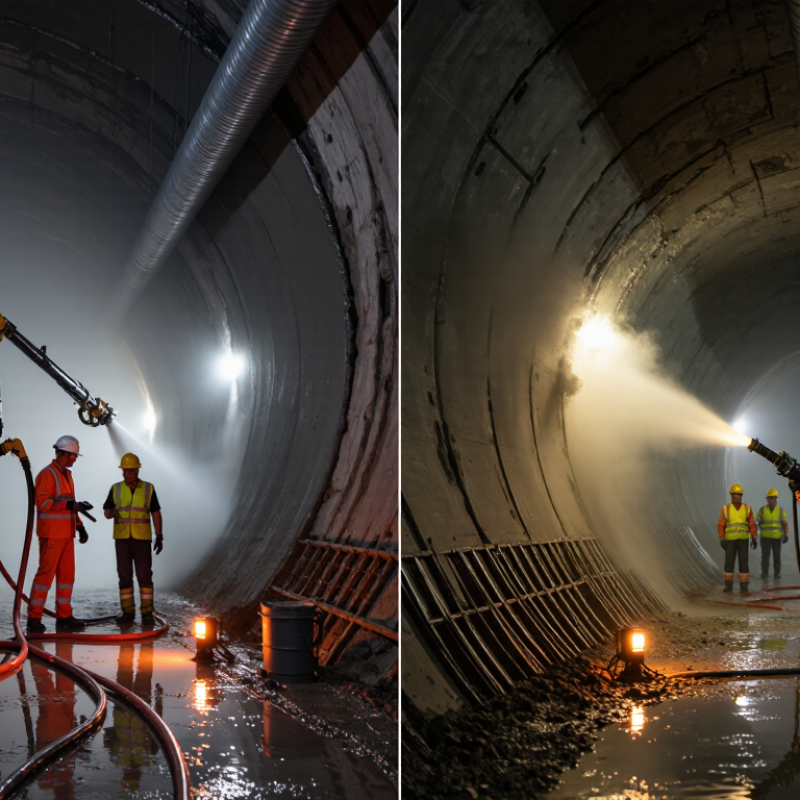
Why Choose Wet or Dry Shotcrete Which Is Better?

What Are Wet Shotcrete and Dry Shotcrete?

Wet shotcrete is a concrete mixture prepared with water before it enters the pump. A pump moves the material through a hose, while compressed air sprays it onto the surface. The nozzle operator controls the application distance and angle. This method usually creates less dust around the work area. It can also deliver a steady flow for tunnels, retaining walls, and large repairs.

Dry shotcrete keeps the dry ingredients separate from water until they reach the nozzle. Compressed air carries the mix through the hose, and the operator adds water at the final stage. This process allows quick adjustments when the surface changes. It suits smaller repairs, overhead work, and locations where equipment access is limited. The operator’s skill is critical. Too much water can weaken the layer, while too little water causes poor bonding and extra rebound.

Neither method is automatically better. Site conditions decide. Wet shotcrete often improves productivity on larger projects, but it needs reliable pumping equipment and careful mix control. Dry shotcrete may offer greater flexibility, yet it can produce more dust and depends heavily on nozzle technique. I have seen a well-designed mix perform poorly because the surface was dusty or the curing was neglected. That detail is easy to overlook. A practical choice considers project size, access, ventilation, required thickness, crew experience, and inspection records. Even experienced teams should check moisture, rebound, and bond strength during application.

How Do Wet and Dry Shotcrete Application Methods Work?

Wet and dry shotcrete use the same basic principle: concrete is projected at high velocity onto a surface. Their delivery systems differ. In wet-mix shotcrete, cement, aggregate, water, and admixtures are blended before pumping. Compressed air then accelerates the mixture through the nozzle. This method usually provides steadier water control and higher production. It suits tunnels, retaining walls, and large repairs.

Dry-mix shotcrete keeps the ingredients dry inside the delivery hose. Water enters at the nozzle, where the operator adjusts hydration in real time. This setup reduces equipment cleaning and works well for remote repairs or intermittent spraying. However, nozzle technique becomes critical. An incorrect angle can increase rebound, dust, and uneven compaction. Short answer: skill matters greatly.

The U.S. OSHA respirable crystalline silica standard sets an action level of 25 micrograms per cubic meter and a permissible exposure limit of 50 micrograms per cubic meter, averaged over eight hours. Wet mixing can help control airborne dust, but it does not remove the need for ventilation and monitoring. ACI 506R-16 explains that rebound, thickness, and bond depend on mixture design, nozzle distance, impact angle, and operator control. EFNARC guidance also emphasizes trial panels and qualification testing before production spraying. The uncomfortable point is simple: wet is not automatically better. A poorly managed wet mix may segregate or block hoses, while a well-controlled dry mix can deliver excellent placement.

Why Choose Wet or Dry Shotcrete Which Is Better? - How Do Wet and Dry Shotcrete Application Methods Work?

Comparison Dimension Wet-Mix Shotcrete Dry-Mix Shotcrete Practical Selection Guidance
How the process works Cement, aggregate, water, and admixtures are mixed before being pumped through the delivery line. Compressed air is added at the nozzle to project the concrete onto the surface. Dry ingredients are conveyed through the hose. Water is introduced at the nozzle, where the operator controls the final water addition and spray consistency. Choose wet mix when consistent, high-volume production is important. Choose dry mix when flexibility and precise water control are more valuable.
Typical production rate Often approximately 6–30 m³/h, depending on pump capacity, hose length, mix design, access, and crew organization. Often approximately 1–10 m³/h, depending on the dry-mix machine, aggregate grading, hose arrangement, and nozzle operation. Wet mix is generally more efficient for large-volume lining or structural work. Dry mix is well suited to small or intermittent repairs.
Water control Water is measured during batching, allowing consistent water-to-cement control when the batch plant and pump are properly managed. Water is adjusted at the nozzle, allowing the operator to respond to changing surface conditions and application requirements. Wet mix offers better batch consistency; dry mix offers greater real-time adjustment but requires a highly skilled nozzle operator.
Material rebound Commonly lower than dry mix, often around 5–15% under favorable conditions and competent application. Commonly higher, often around 10–30%, especially on corners, overhead surfaces, irregular rock, or with poor nozzle technique. Actual rebound depends on air pressure, nozzle angle, surface profile, mix grading, layer thickness, and operator skill. Site trials are recommended.
Dust and workplace exposure Generally produces less dust because the material is pre-dampened before entering the hose, although spraying still requires effective ventilation and respiratory protection. Generally produces more dust because dry cement and aggregate are conveyed through the hose and water is added at the nozzle. Wet mix is usually preferable in enclosed spaces when dust control is a major concern, subject to suitable ventilation and exposure controls.
Equipment and logistics Requires a wet-mix pump, mixer or ready-mix supply, water management, delivery lines, and usually a larger support area. Uses a dry-mix gun or rotor machine, compressed air, water supply, and comparatively compact material storage. Dry mix is often easier to mobilize in restricted locations. Wet mix can be more productive when reliable concrete delivery is available.
Hose and delivery considerations Pumping wet concrete requires suitable hose diameter, mix workability, pump pressure, and careful control of stoppages to reduce blockage risk. Dry material can often be conveyed over considerable distances, but hose bends, moisture, aggregate grading, and rotor settings can affect flow. The preferred method depends on access, vertical lift, hose length, power availability, and the ability to maintain uninterrupted delivery.
Layer thickness and overhead work Can place relatively thick layers efficiently, but the allowable thickness per pass depends on the mix, reinforcement, accelerator, orientation, and project specifications. Can be effective for overhead and localized applications because the material is placed in thinner, controllable passes. Neither method has a universal thickness limit. Follow the approved mix design, structural requirements, and application trials.
Strength and quality potential Can achieve high and consistent strength when batching, pumping, compaction, curing, and quality control are well managed. Can also achieve high strength and durability, but results depend strongly on nozzle technique, water dosage, mixing quality, and curing. Application method alone does not determine performance; the mix design and execution quality are critical.
Best-suited applications Large tunnels, mines, retaining structures, slope stabilization, structural repairs, and projects requiring continuous high output. Small repairs, patching, rock and soil stabilization, overhead work, remote locations, and projects with irregular or intermittent demand. Match the method to volume, access, geometry, dust restrictions, required finish, crew expertise, and material supply.
Overall advantages Higher output, lower rebound in many conditions, reduced dust, and more uniform water measurement. Compact setup, lower minimum production commitment, flexible water adjustment, and good suitability for remote or small-scale work. Wet shotcrete is often better for high-volume controlled production; dry shotcrete is often better for flexibility, mobility, and small quantities.

Note: Production, rebound, and performance figures are typical industry ranges rather than guaranteed values. Actual results vary with mix design, aggregate moisture and grading, equipment, nozzle distance and angle, surface conditions, crew skill, and site specifications.

What Are the Main Differences Between Wet and Dry Shotcrete?

Why Choose Wet or Dry Shotcrete Which Is Better?

Wet and dry shotcrete differ mainly in material preparation, water control, dust, and application speed. Wet shotcrete arrives with cement, aggregate, and water already mixed. This produces steadier hydration and usually reduces rebound on walls and overhead surfaces. EFNARC guidance commonly reports lower rebound for wet spraying, often around 5–15%, compared with higher losses in dry spraying. Actual results depend on nozzle angle, air pressure, mix design, and operator skill.

Wet Shotcrete Wet shotcrete arrives with cement, aggregate, and water already mixed. This produces steadier hydration and usually reduces rebound on walls and overhead surfaces.

Dry Shotcrete Dry shotcrete carries a dry blend through the hose. Water enters at the nozzle, allowing the operator to adjust moisture during placement. This method suits remote sites, repair work, and projects needing longer material storage.

It also creates more dust. OSHA limits respirable crystalline silica exposure to 50 micrograms per cubic meter over eight hours, under 29 CFR 1926.1153. Ventilation and wet suppression remain essential.

Wet systems usually offer better production consistency. Dry systems can respond faster to changing surface conditions. Neither method is automatically superior.

A poorly adjusted wet mix may sag, while a skilled dry nozzleman can produce dense, strong concrete.

ACI 506R-16 emphasizes nozzleman training, substrate preparation, and quality testing. I have seen the same mix behave differently after a temperature change. That detail is easy to underestimate. Project access, required thickness, dust controls, rebound allowance, and inspection capacity should guide the choice.

Which Shotcrete Method Performs Better in Different Conditions?

Shotcrete performance changes with access, moisture, geometry, and crew skill. Wet-mix concrete arrives preblended with water, so its moisture content is easier to monitor. It usually creates less dust and steadier placement on large walls or tunnel linings. It needs discipline. Pump pressure, hose condition, and nozzle distance still affect rebound and compaction. A qualified supervisor should verify the mix design, air content, strength tests, and curing plan before production.

Dry-mix shotcrete keeps water separate until the nozzle. This makes it useful where transport is difficult, work is intermittent, or small repairs need quick setup. Dry is faster. Skilled nozzle operators can adjust water at the surface, which helps with overhead work and changing substrates. That flexibility has a cost: too little water weakens hydration, while too much increases sag and shrinkage. Dust control, ventilation, and protective equipment also require close attention.

Different conditions favor different methods. Wet mix often suits high-volume structural work with reliable pump access and consistent batching. Dry mix can perform well in confined repairs, remote slopes, and projects needing frequent stops. Neither method automatically produces better concrete. Trial panels should check adhesion, rebound, finish, and early strength under actual site conditions. I would not rely on a neat rule here. Weather, aggregate moisture, nozzle technique, and inspection records can overturn the first choice. A small trial may reveal that the apparently cheaper method demands more labor, more cleanup, or repeated applications.

How Should You Choose Between Wet and Dry Shotcrete?

Choosing between wet and dry shotcrete starts with the site, not the pump. Wet shotcrete suits projects requiring steady, high-volume placement and lower dust exposure. ACI 506R-16 reports typical wet-mix outputs of about 4 to 15 m³ per hour. It also generally produces less rebound when crews control water, pressure, and nozzle distance.

Dry shotcrete remains valuable where access is difficult or spraying happens intermittently. The material travels dry, so the crew can adjust water at the nozzle. This helps in tunnels, slope repairs, and remote stabilization work. However, dust control becomes critical. EFNARC guidance commonly places dry-mix rebound near 15–30%, while wet-mix rebound often falls near 5–15%. These figures are practical ranges, not promises.

Look at daily volume first. Then inspect the substrate.

For a small repair, dry shotcrete may reduce setup time and material waste. For continuous lining, wet shotcrete usually offers better consistency and production. Reinforcement density also matters. Dense steel can demand stronger pumping capacity and a highly skilled nozzle operator.

ACI 506R-16 emphasizes nozzleman training, while EN 14487-2 stresses application control and quality testing. Those details often decide performance more than the selected process. A neat calculation can still mislead. Wind, rebound collection, hose length, and operator experience may change the result. Request trial panels, measure rebound, and compare actual output before committing to either method.

Why Choose Wet or Dry Shotcrete? Which Is Better?

Wet shotcrete generally provides higher application output, lower rebound, and less airborne dust. Dry shotcrete typically offers simpler equipment, better suitability for intermittent work, and longer material storage before mixing.

The chart uses representative midpoints from commonly reported engineering ranges. Actual results vary with mix design, nozzle technique, equipment, substrate, ventilation, and site conditions.

FAQS

How does wet-mix shotcrete work?

Cement, aggregate, water, and admixtures are blended before pumping. Compressed air then drives the mixture through the nozzle. It suits tunnels, retaining walls, and large repairs. Production is usually steadier.

How does dry-mix shotcrete work?

Dry ingredients travel through the hose. Water enters at the nozzle. The operator adjusts hydration during spraying. This method suits remote or intermittent repairs. Technique matters greatly.

When is wet-mix shotcrete usually the better choice?

Choose it for continuous, high-volume placement. Typical output may reach 4 to 15 cubic meters per hour. It usually creates less dust and rebound. Poor water control can still cause blockage or segregation.

When can dry-mix shotcrete be more practical?

Dry-mix can reduce setup time for small repairs. It also works where equipment access is difficult. Crews can stop spraying without keeping a wet mixture moving. The result depends heavily on nozzle skill.

How does rebound differ between the methods?

Wet-mix rebound often falls near 5–15%. Dry-mix rebound may reach about 15–30%. These are practical ranges, not guarantees. Nozzle angle, distance, pressure, and material design can change the result.

Does wet mixing eliminate silica dust concerns?

No. Wet mixing can reduce airborne dust, but ventilation remains necessary. Monitoring and suitable respiratory protection may still be required. Dust control is a management task, not an automatic benefit.

Why are nozzle angle and distance important?

A poor angle can increase rebound and create uneven compaction. Excessive distance may weaken placement control. The operator should maintain consistent movement and spacing. Small adjustments matter.

Should a crew test the process before production spraying?

Yes, trial panels can reveal rebound, thickness, bond, and surface defects. Measure actual output and material waste. Check the substrate and reinforcement density. A neat calculation may still mislead.

Which method works better around dense reinforcement?

Dense steel may require stronger pumping capacity and careful nozzle control. Wet-mix can provide consistent delivery during continuous work. Dry-mix may still work with an experienced operator. There is no universal winner.

Conclusion

Wet and dry shotcrete are two practical methods for placing concrete at high velocity onto surfaces such as tunnels, slopes, walls, and structural repairs. Wet shotcrete mixes cement, aggregates, water, and often additives before pumping, which provides consistent hydration, lower dust, and high productivity for large projects. Dry shotcrete, sometimes called gunite, conveys a dry mixture through the hose and adds water at the nozzle, allowing operators to adjust moisture during application and work effectively in smaller or more controlled areas.

Understanding what is the difference between wet and dry shotcrete helps project teams select the right method. Wet shotcrete is generally preferred when rapid placement, reduced rebound, and uniform quality are priorities, while dry shotcrete can offer greater flexibility, easier equipment setup, and better control for intermittent work or difficult access. The best choice depends on project size, surface conditions, required strength, available equipment, labor skills, environmental controls, and scheduling requirements.

Madeline

Madeline

Madeline is a dedicated marketing professional with a wealth of expertise in our company's core offerings. With a keen understanding of the industry, she brings a unique perspective to her role, consistently delivering high-quality content that highlights the superior aspects of our products. As......